
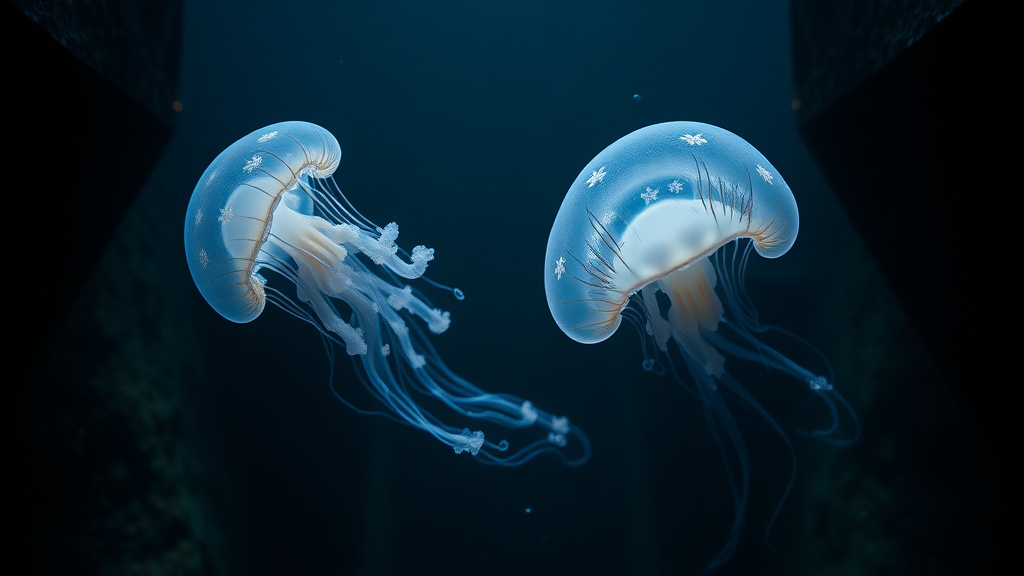
In a groundbreaking discovery that enhances our understanding of life in Earth’s harshest environments, scientists have identified a extraordinary new species of jellyfish thriving in the crushing depths of ocean trenches. This bioluminescent creature, discovered thousands of meters below the surface where sunlight fails to reach, questions our assumptions about where life can survive. The expedition reveals stunning adaptations that allow this delicate organism to survive in highly pressurized environments and endless darkness, promising compelling insights into abyssal environments.
Discovery and Identification
Early Detection
During a deep-sea exploration mission in the Mariana Trench, research vessels equipped with sophisticated underwater vehicles captured the initial photographs of this extraordinary jellyfish species at depths exceeding 6,000 meters. The creature’s unique glowing patterns immediately caught the attention of ocean researchers monitoring the expedition in real-time. These glowing tentacles, radiating ethereal blue and green light, offered the initial visual evidence of a species previously unknown to science. The team carefully documented every movement and characteristic before attempting any collection efforts.
Early findings showed structural features markedly different from any catalogued jellyfish types. The creature exhibited an distinctive bell form with reinforced material capable of withstand extreme pressure fluctuations. Researchers noted its remarkable capacity to produce light without external stimulation, indicating sophisticated internal bioluminescent organs. The specimen dimensions, roughly 30 centimeters in diameter, classified it as a medium-sized deep-water jellyfish. These initial results led to immediate calls for additional scientific missions to collect more specimens.
Lab Testing
Once specimens were properly acquired and delivered to research facilities, comprehensive genetic analysis started promptly. DNA sequencing revealed the jellyfish represents an wholly distinct genus within the Cnidarian phylum, demanding the establishment of novel systematic groupings. Genetic comparisons with established abyssal species showed marked variation, suggesting millions of years of independent evolutionary change in the deep-sea setting. Researchers classified the species Atolla hadalis profundis, indicating its habitat in the hadal zone’s deepest regions. The genetic findings fundamentally changed understanding of jellyfish evolutionary diversity.
Microscopic examination of biological specimens uncovered striking biological modifications not yet recorded in jellyfish. The organism’s mesoglea housed adapted pressure-resistant proteins that preserve structural integrity under harsh environments. Photophore cells responsible for bioluminescence exhibited unique configurations allowing efficient light production in complete darkness. Chemical analysis identified novel compounds in the creature’s tissue composition, potentially valuable for pharmaceutical research and biotechnology applications. These findings established the newly identified species as a subject of intense scientific interest and continued study.
Verification and Record-Keeping
The scientific community demanded rigorous verification before formally accepting this novel species. Numerous independent research teams conducted their own analyses of obtained samples, confirming the preliminary findings through distinct methods. Review processes scrutinized every component of the investigation, from sampling procedures to genetic data and morphological characteristics. International marine biology journals developed special publications dedicated to comprehensive documentation of the findings. The cooperative verification effort strengthened the credibility and importance of this significant discovery.
Extensive photographic and video records provided an essential account of the jellyfish’s behavioral patterns in laboratory conditions. 3D imaging methods generated precise anatomical models for comparative studies in the future. Scientists released extensive field notes detailing the specific location, depth, and environmental factors of the initial discovery site. These detailed documentation enable other researchers to find and examine the organism in its natural setting. The comprehensive documentation confirms this landmark discovery supports the broader scientific community for many decades.
Qualities and Evolutionary Changes
The recently identified deep-sea jellyfish displays a transparent, gel-like body structure specially adapted to harsh deep-sea conditions. Its dome-like body measures around 15 centimeters in diameter, with elongated tentacles stretching several times its body length. The creature’s delicate makeup enables it to withstand massive pressure variations found at depths exceeding 6,000 meters, where very few organisms can survive such hostile environments.
This exceptional species exhibits remarkable physiological modifications formed through countless generations of evolution in isolation. Its tissues feature specialized proteins that sustain flexibility under extreme force while withstanding the low temperatures near freezing. The jellyfish’s minimal metabolic requirements permit survival in nutrient-scarce environments, depending on passive feeding mechanisms to capture tiny organisms drifting through the water column.
Bioluminescent Features
The jellyfish’s most distinctive quality is its sophisticated bioluminescent system, emitting ethereal blue and green light output throughout its body. These glowing structures serve several key functions, from attracting prey to signaling to potential mates in the absolute darkness of the deep ocean. The strength and sequence of luminescence can be controlled by the creature, allowing it to modify luminescence based on external conditions and behavioral needs.
Scientists have recognized specialized photophores—light-producing organs—distributed across the jellyfish’s bell and tentacles. These structures hold luciferin and luciferase proteins that produce light through biochemical processes, producing an captivating spectacle visible only in deep-ocean environments. The bioluminescent capability constitutes a significant evolutionary advantage, permitting the jellyfish to move, feed, and breed in perpetual darkness where sight-reliant predators cannot function.
- Cyan-hued emissions visible across bell and tentacles
- Photophores positioned throughout body structure
- Light production controlled by specialized neural networks
- Bioluminescence attracts small crustaceans and plankton prey
- Glow pattern changes during mating and territorial displays
Research Findings and Upcoming Research
Expanding Our Knowledge of Abyssal Ecosystems
The discovery of this new jellyfish species has significant implications for our knowledge of deep-sea biodiversity. Scientists now acknowledge that ocean trenches contain far more complex ecosystems than previously believed. This discovery questions traditional models of species distribution patterns and survival strategies in harsh environments. Future research will concentrate on identifying additional species in these regions and understanding the interconnected food webs that sustain such remarkable organisms in complete darkness.
The luminescent characteristics of this jellyfish create opportunities for examining light production in extreme conditions. Researchers are eager to investigate how this species produces luminescence without access to surface resources. These studies could revolutionize our understanding of biochemical processes in deep-sea organisms. Understanding these mechanisms may lead to breakthroughs in biotechnology and medical applications, showing how fundamental research in marine biology can deliver tangible advantages for human innovation and advancement.
Upcoming Exploration and Preservation Priorities
Researchers are organizing comprehensive expeditions to map additional trench ecosystems and document species diversity in these unexplored regions. Cutting-edge underwater vessels and robotic exploration tools will enable researchers to access previously unreachable depths. These expeditions will collect specimens, ecological information, and genetic samples for comprehensive examination. Global cooperation will be essential for organizing collaborative work and sharing findings across the worldwide research network.
Preservation efforts must go hand in hand with scientific exploration to safeguard these delicate deep-sea environments. As human activities continue to affect ocean ecosystems, establishing protected zones in trenches becomes crucial. Researchers advocate for worldwide standards controlling deep-sea extraction and resource harvesting. Understanding the ecological value of these habitats means future generations can continue studying and appreciating the extraordinary creatures that inhabit Earth’s final frontier.
Technological Advances and Research Possibilities
This discovery demonstrates the critical need for supporting cutting-edge marine tools and ocean floor exploration capabilities. Contemporary underwater vessels equipped with advanced imaging and collection equipment have enabled these findings feasible. Ongoing investment for marine research infrastructure will advance our understanding of ocean depths. Academic institutions and research centers worldwide are creating advanced tools for studying extreme environments, promising unparalleled entry to hard-to-reach environments.
The jellyfish identification motivates cross-disciplinary study merging marine biology, genetics, and environmental science. Universities are creating dedicated research programs focused on deep-sea organisms and their adjustments. Cooperative alliances between institutions support knowledge sharing and resource pooling. This progress in deep-sea research promises transformative discoveries about life’s resilience and adaptability, ultimately improving our thorough knowledge of Earth’s biosphere.
