
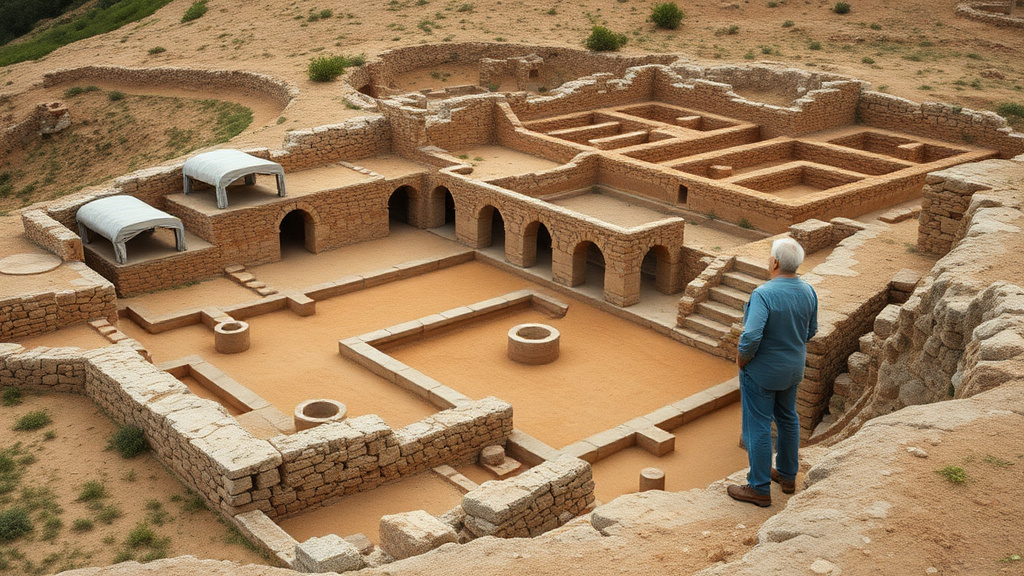
Transformative discoveries are transforming our understanding of Roman civilization. Using advanced ground penetrating radar technology, archaeologists have uncovered a remarkably preserved Roman settlement hidden beneath layers of earth for nearly 2,000 years. This groundbreaking technique allows researchers to investigate below the surface without destructive digging, revealing complex information of structures, artifacts, and everyday activities. Explore how this technological innovation is reshaping archaeological practice and what these significant discoveries reveal about Roman settlement patterns.
Revolutionary Discovery Methods
Ground penetrating radar technology represents a paradigm shift in archaeological investigation. This non-invasive imaging technique employs electromagnetic waves to locate underground features without damaging the soil. By interpreting how these waves reflect off buried structures and artifacts, researchers can produce comprehensive maps of buried arrangements. This method proved essential at the Roman site, where GPR located structural foundations, roads, and pottery deposits with exceptional accuracy, allowing archaeologists to plan targeted excavations systematically.
The benefits of GPR technology surpass mere convenience. Traditional excavation methods risk destroying delicate artifacts and irreplaceable archaeological contexts. GPR surveys maintain site preservation while delivering detailed information about spatial relationships and settlement organization. Furthermore, this technology accelerates the discovery process significantly, permitting experts to cover vast areas efficiently. The Roman settlement’s successful identification illustrates the way modern technological innovation enhances our ability to unlock ancient secrets while respecting the sanctity of historical sites for subsequent investigation and future scholars.
The Roman Community Findings
The excavation brought to light a extensive Roman settlement originating in the 2nd century CE, complete with residential structures, public buildings, and commercial establishments. The site covers approximately three hectares and exhibits sophisticated town layout typical of provincial Roman towns. Ground penetrating radar located numerous subsurface features, such as foundations, roads, and underground storage facilities. The settlement’s layout suggests a thriving community with distinct residential and commercial zones, offering invaluable insights into Roman provincial life and architectural practices in this era of prosperity.
Physical Structures and Artifacts
Archaeologists found remarkably well-preserved stone base structures belonging to at least fifteen living quarters, along with what appears to be a small forum and government structure. The structures exhibit typical Roman building methods, such as opus caementicium concrete and precisely laid stone slabs. Numerous artifacts recovered from the site include pottery fragments, coins, tools, and decorative items that shed light on everyday life and trade connections. These findings suggest the settlement sustained robust commercial networks reaching across the Roman world, promoting exchange of goods and ideas over long distances.
The artifact assemblage offers strong indicators of class divisions within the community, with high-value goods suggesting wealthy inhabitants alongside more utilitarian objects linked to lower-class residents. Imported ceramics from Mediterranean regions reveal the settlement’s integration into broader Roman trade networks. Personal items such as jewelry, hairpins, and writing implements provide insight into personal existence and household activities. The diversity and quantity of artifacts recovered underscore the settlement’s significance as a regional economic hub sustaining varied communities and commercial enterprises.
Dating and Historical Significance
Multiple dating techniques, including radiocarbon analysis and ceramic typology, verify the settlement prospered during the second and third centuries CE, a period of considerable Roman expansion in the region. This chronological framework situates the site within a critical era of provincial development and material wealth. The settlement’s establishment coincides with significant Roman building programs and military campaigns that consolidated control over peripheral areas. Comprehending this temporal framework helps archaeologists reconstruct territorial historical records and appreciate how local communities adjusted to Roman imperial rule and profited from integration into the wider empire.
The finding holds substantial historical significance for scholars studying Roman provincial communities and urbanization patterns. This site provides uncommon archaeological findings of how Romans established and maintained communities in outlying areas, adapting their architectural and administrative systems to local conditions. The settlement’s evident wealth and endurance suggest effective assimilation with surrounding populations and efficient management of resources. These results add significantly to wider conversations about Roman territorial growth, spread of culture, and the ways in which Rome preserved its vast territorial dominion across centuries.
Ground Penetrating Radar Technology
GPR technology, often referred to as GPR, represents a groundbreaking innovation in archaeological exploration. This non-destructive method utilizes radio frequency signals to create detailed subsurface images without disturbing the soil. By transmitting radio waves into the ground and examining their reflections, archaeologists can detect buried structures, artifacts, and subsurface characteristics with exceptional accuracy. The technology has proven invaluable in uncovering the ancient Roman site, enabling teams to map structural bases, pathways, and storage structures before any excavation begins.
The benefits of GPR technology surpass simple detection capabilities. This method significantly reduces excavation costs while maintaining archaeological contexts that traditional digging might compromise or obliterate. The detailed 3D mapping data generated by GPR enable archaeologists to create focused excavation strategies, directing attention on the most promising areas. Furthermore, the technology offers thorough insight of entire settlements, exposing layout connections and urban planning patterns that would otherwise stay concealed beneath centuries of layered sediment.
- Electromagnetic waves pass through soil layers detecting buried structures
- Non-invasive method preserves site integrity and integrity
- Creates detailed three-dimensional underground survey data
- Decreases excavation costs and duration significantly
- Enables focused investigation strategies for maximum efficiency
